Sunday, 22 March 2015

Håtunaleken – The Host of Birger Magnusson


This is my starter "half host" (i.e. 12 points) for our latest club project Håtunaleken ("The Håtuna Games"). Some of you may have spotted these in my mate Dalauppror's AAR posted a while back, but here are some more detailed pictures together with some background for this fascinating period of Swedish history.

Corbel of Birger Jarl in Varnhem Abbey Church.

During the later parts of the 13th century Sweden had become a catholic monarchy in the vein of the larger kingdoms of Western Europe, thanks to the stability enforced by the mighty Birger Jarl of the House of Bjälbo – the last person to hold the old title of Jarl. In his role as adviser to the king, he had become so powerful that he could be seen as the de-facto ruler instead of the weaker monarch. Birger's crowning achievement was when he eventually managed to place his son, Valdemar, on the throne. The country was at this time an election-kingdom and thus the titel of king was not hereditary.

King Birger Magnusson of Sweden.
Painting from St. Bendt's Church in Ringsted, Denmark, where he is buried.

Valdemar was later usurped by his envious younger brothers Magnus and Erik, who defeated him in the battle of Hova and then forced him to resign. Instead Magnus, who later earned the epithet Ladulås ("Barnlock"), was now declared king and, like his father, appointed his son – Birger Magnusson – to succeed him. However, as Birger was very young when his father died, a Lord High Constable, Torgils Knutsson, ruled in his stead until the king was old enough to be crowned and take over the reign.

Torgils became very powerful indeed, at times he was probably the most powerful man in the kingdom, and spent some of his time conquering lands to the east, enlarging Sweden across the Baltic Sea.

Sibling rivalry obviously ran in the family, for when the time came for Birger's crowning in 1302, it was now time for his younger brothers Erik and Valdemar to rebel. After much skirmishing and raiding between both sides, in 1304 the brothers had to bow before Birger and Torgils Knutsson and recognize their superiority. However, the bitterness of the defeat soon saw the two brothers once again plotting to overthrow the king.


They began undermining his authority, and one of their key targets was Torgils Knutsson, who had remained a close ally and trusted advisor to Birger. The brothers managed to convince the king that the Lord High Constable had become too powerful and now posed a threat to not only Erik and Valdemar but also to Birger himself. In 1305 the three brothers had Torgils Knutsson arrested and executed in Stockholm. He was later buried in unsacred earth like a common criminal.


But Erik and Valdemar was of course not content with this. In 1306 the brothers arrived at the king's estate Håtuna by the lake Mälaren. As the three of them now seemed to be on good footing, Birger suspected no foul game and received Erik and Valdemar as friends and threw a feast in their honor. However, the brothers had other plans – during the night their men captured the king and the queen and took them to Nyköpings hus (Nyköping Castle) were they where held prisoners.


After this coup – which later became know as Håtunaleken, although the whole feud/power struggle is called andra brödrafejden ("the second feud of brothers", the first being the feud between their father Magnus Ladulås and his brothers) – Erik ruled as king, but was almost immediately thrown into a war with Denmark who was firmly on the side of Birger due to close family-ties with the Danish royal family.


Erik had in his turn close family-ties with the Norwegian royal family and had expected support from them in the ensuing fighting. However, the Norwegian king was growing worried about Erik's increasing power, especially as he had a very strong power-base in what is now the western parts of Sweden, close to Norway. Lacking the necessary support, Erik had to seek a truce. Birger and his queen were released, and Sweden was now split between the three brothers and in practice ruled as three independent kingdoms.


Birger wanted revenge after the humiliation suffered at the hands of his brothers, and revenge he would get ... But that is another story for another time!


The models are all from Gripping Beast. The sculpting is quite nice although some of the castings were a bit rough, perhaps showing the age of the moulds.

The look I wanted was a "varied uniformity", fitting for a medieval army. The main colours are from the arms of the House of Bjälbo, white and blue, but as I didn't want the models to look too uniform I tried to vary where the colours were applied.


This is the model I chose to represent Birger Magnusson, the king, together with his closest men. He is wielding an old family weapon – a might dane axe who is said to have belonged to the mythical progenitor of the House of Bjälbo, Folke Filbyter. (This is all made up by me, in reality, if Birger himself ever fought I guess he would have been equipped with a sword or maybe a mace, like every other knight of the time.) One fun detail: When rolling for his Talent, I got Rash, which seems to fit this model perfectly!

The lions on the shields are overpainted transfers. I choose only to apply them to a couple of the models to get a more varied look.


For the banners, I made a basic black and white design in Adobe Illustrator and InDesign before printing it out in two different sizes on paper and then painting over the outlines, doing shading and highlights as usual. This was my first attempt at this technique and I'm pretty happy with the results.


I'm in the process of painting up another 12 points for this force by adding some more mounted knights together with some allmoge – Swedish yeomens who often fought in mixed formations, armed with spears/polearms and crossbows.


Have a great week everyone and thanks for reading!

Wednesday, 11 March 2015

Italian Wars French 5 – Reisläufers 5

After a long involuntary break, I'm finally back with some painted miniatures. During the later parts of January and for most of February, the family's been plagued with various colds, flus and other ailments leaving me precious little time for the hobby. What little time I could scrape together has been focused on painting rather than blogging. But now, spring most definitely is in the air here in Stockholm, and the dreaded "sick period" seems to be behind us, which hopefully means more time for both painting and blogging.

To kick things off, here are the last miniatures to be finished for my two Swiss mercenaries pike blocks to be used in my Italian Wars French army: fashionably late, it's the commanders.


The models are all from Foundry, lovely sculpts with lots of character.


With these miniatures I made the conscious effort to go for bolder "steps" and increase the contrasts on the highlights, as I have become increasingly frustrated with my painting style lately, feeling it doesn't "pop" enough on the gaming table. I'm very happy with how these efforts payed off, and this is a direction I will try to strive towards in the future.


The flags are painted by me and based on designs I found on the Internet, more specifically on the excellent blog Camisado. A highly recommended blog, especially if you're into the wars in Italy during the 16th century. The flags represent the cantons of Bern (the bear) and Uri (the bull) respectively.


The flags are removable, for easier storage and for when I want to swap them – in the event I'm fielding these as Landsknechts they obviously can't have Swiss flags!


Here are some pictures of the two complete pike blocks.


Of course I now want to add another 3 bases to each block, for a truly massive amount of pikes. But this will have to wait until I finish some gendarmes and artillery pieces.

Thank you very much for reading!

Sunday, 18 January 2015

Italian Wars French 4 – Reisläufers 4


Sometime in late November (I think?) last year, I finished another two bases of mercenary pikemen for my Italian Wars project. Today, I finally took the time to photograph them.

Like the last two bases finished, these are in an attacking pose with leveled pikes – very unpractical for storing and playing but they certainly do look the part.


The miniatures are once again from Foundry's lovely Renaissance range, sculpted by Michael Perry way back.


Unfortunately the matt varnish seems to have killed some of the brightest highlights, making them look a bit flat. I have never had any problems with this varnish before (Windsor&Newton Galleria Matt Varnish), and I've been using it exclusively for the past three or four years. It seems I may have gotten a bad pot, and I've since bought a new one that seems to work as it should. When I get around to it, hopefully another coat (the third) will restore at least some of original highlights.


Finally, I couldn't resist taking a picture of an almost finished unit. Lots of pikes here!


I'm working on the command bases now, and then these two units will finally be finished. It's been a bit of a slog to be honest, but I think the result will be worth it.

As always, thanks for reading!

Tuesday, 6 January 2015

Projects for 2015

With 2014 firmly in the books it's now time to lay down the plans for this year. As usual I like to set myself some official goals to help with the motivation. However, last year this trick did not really work as hoped as I mentioned in my review of 2014, so for 2015 it's time to focus and get back on track – no more procrastinating!

For this year, I have set myself some rather strict, but hopefully manageable goals:

Italian Wars French


After last year's failure, no more excuses, I will finish my planned starter force for this army during this year. Simple as that.

Håtunaleken


For our Lion Rampant club project, I will add the next couple of units to my host to bring the total points up the regular 24. The current plan is to do some more mounted knights and a unit of foot yeomen with mixed weapons (allmoge). I also plan to do a mounted and an unmounted version of the leader of my host – i.e. the king Birger Magnusson.

Great Northern War


Ever since leafing through my parents' copy of the classic "Karoliner" at age 10, the image of these iconic Swedish soldiers has been firmly planted in my mind. When the new club project for the GNW was announced, I naturally signed up to paint a unit. Our plan is to put on a display game at the Lincon gaming convention in May, so there's a strict deadline to paint to which always works wonders for my motivation.

Operation Winter Storm


I have long been wanting to do some serious WW2 gaming, preferably on the eastern front as it's such a fascinating theatre of war. The ferocious fighting – on all levels of operation, from the large scale to the small scale – and the horrible conditions both sides found themselves in, give the whole thing an almost mythical air. After purchasing this excellent scenario pack for Chain of Command, I knew I had found the perfect project to get started on some eastern front gaming.

The plan is to do everything required for the first 14 (of 22 in total) scenarios during 2015: paint up all the models for both the Germans and the Soviets and make all the terrain. I'm looking at doing this project in 15 mm, which has a number of benefits such as low cost, quick painting time, lots of suitable models from different manufacturers available, and the fact that I already have most of the German infantry needed (although unpainted). There's also some of the club's terrain that can be used which will save me some work.

I have a somewhat sketchy plan to eventually "upgrade" to playing at company level, using the I Ain't Been Shot Mum rules, by expanding the forces some time in the future. This is a rather long-term plan though, so it won't happen this year.

Well, these projects should keep me sufficiently occupied during 2015. Now, all I have to do is stick to the plan and not get seduced by all the fun distractions that inevitably pop up along the way – always the greatest challenge of them all!

Friday, 2 January 2015

2014 in Review


First off, a belated Happy New Year everyone!

Gosh, is it another year already? Well then, it seems I have to do the traditional report on what has happened during the last year


In 2014 my hobby was of course affected by the arrival of our new baby. This has caused a bit of an upheaval on the home front, to say the least, but I've actually had more time to paint than I thought, when I haven't been too tired that is. However, getting away for an evening of gaming has been more or less impossible since mid October. Up until then it was a very good year gaming-wise though, with lots of fun games and a great mix of periods – from the dark ages through the medievals to the 17th and 19th centuries. Highlights include finally starting our Dux Britanniarum campaign, getting my complimentary copy of Lion Rampant where we've been part of the play testing as well as helping Michael with his splendid Invasion of Gotland article in WSS #75. Another special highlight was of course finally getting to visit Salute in London, which was every bit as impressive – and wallet emptying ... – as I imagined it would be.

For this year, I'm really looking forward to getting back into some regular gaming when things have settled down a bit on the home front.

A quick rundown of my goals for 2014:

Try at least one new period with one new rules set

Achieved! And by somewhat of a margin too: War of 1812 and the Thirty Years War, using Black Powder and Pike and Shotte respectively. Also, the Scanian War using Donnybrook.

Finishing Saxons for Dux Britanniarum

Achieved! Very easy this one, as it was only some 10 models left on this project from the year before.


Bit and bobs

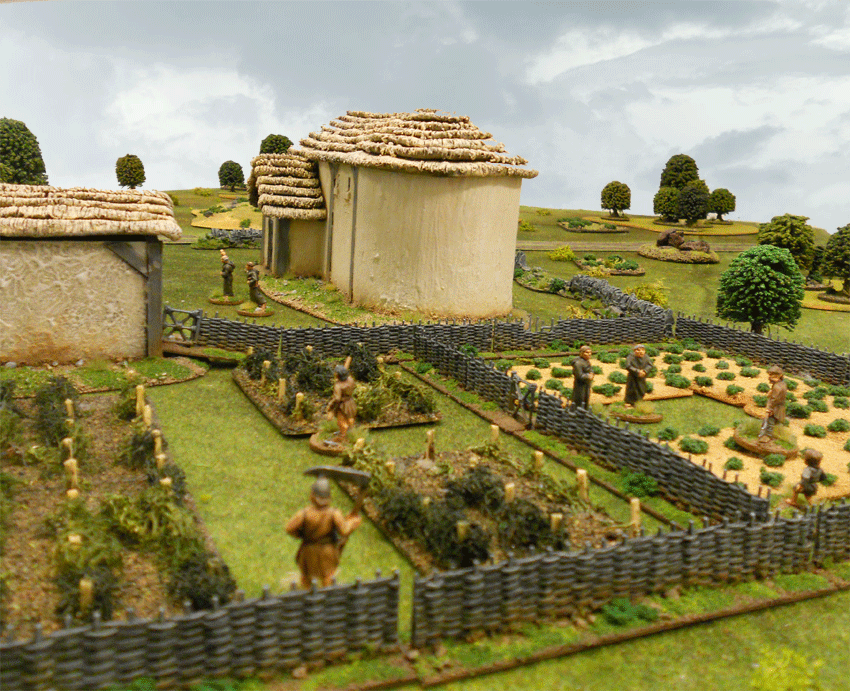
Achieved! I made several terrain pieces – fences, walls, houses and a church – and painted up some loot markers, several types of cattle and domestic animals, medieval civilians, monks and also updating/re-basing my old casualty markers.


Italian Wars French

Fail! Well, what can I say. I lost my painting mojo over the summer, just as I was getting into the groove of this project which meant that even though 10 bases of pikemen were finished, it left me just short of two complete units which is not even close to the goal I set for this year: 2 units of pikemen, 2 units of gendarmes, 1 piece of artillery and a couple of commanders. When I said this was a long term project, this wasn't exactly what I meant!

Romano-Britons for Dux Britanniarum

Fail! Sigh. Not even started.

Instead of painting French and Romano-Britons I managed to finish some other stuff:


Fantasy skirmish

Achieved! To reinvigorate my painting after the "summer slump" I decided to do a smallish fantasy project using Song of Blades and Heroes. For this project I painted up 8 models and made some themed scenery. I really enjoyed doing a quick little project like this, and this is something I could see myself doing more of in the future.

Håtunaleken – Lion Rampant

Partially achieved! This was a club project that was started in November and naturally I had to join in. The first goal for everyone was to paint up a 12 point host for Lion Rampant. I managed to paint up the first unit of 12 foot sergeants and very nearly managed to finish the second unit of 6 mounted men-at-arms too. I'll post some pictures of these units when I get the time to take some snaps of them.

Looking at the numbers, I painted 74 foot and 4 mounted 28 mm miniatures during 2014. These are certainly not very impressive numbers, not when compared to my output from 2013 (137) and 2012 (171). However, in addition to these 74 models I also painted 6 loot markers, 15 animals, 2.8 meters of walls and fences. I also built and painted 5 buildings, including a pretty big church, and painted another 4 pieces of terrain in the form of ruins for the fantasy project. Overall, I'm fairly pleased with my output even though it of course could have been much, much better.

So there it is – the result for 2014. I want to say a big thank you to all you followers who have read and commented on my rambling during the year – it really means a lot to me! I also want to take the time to say a big welcome to all the new followers who have joined during the last couple of months!

I hope you all will have a great year ahead, and that you'll stick around here for some more projects. My plan is to get this blog back on track and go back to the usual routine with updates once a week.

I'll be back with my plans for 2015 in a couple of days.

Tuesday, 18 November 2014

The Fate of Alt Clut – Parts 2–4


A long overdue report on how things stand in our Dux Britanniarum campaign "The Fate of Alt Clut".

We managed to play four games, before taking a break for the summer way back in June. And now, here in November, we're still on that break and I don't think we'll be able to continue with the campaign until some time next year.

Anyway, rather than a detailed account of each game, I'll just do a quick summary and then finish off the post with some thoughts on Dux Britanniarum and the campaign.

The first game was a Pict raid on an Angles village, which ended in a marginal victory for the raiders. You can read more about that game here.

In the second game, it was time for the Picts to test their might against of the Britons of Alt Clut proper. And what an interesting game this turned out to be – it became very clear that playing in a campaign poses and imposes certain challenges on it's own, which is exactly the thing I'm after!

The battlefield, with the church in the middle,
surrounded by fields and a garden.
The Picts arrive from the top edge, and the Britons
from the right edge.

The Picts had their eyes set on a newly erected church just outside Mygedawc, where the holy relics were said to be of much value and the church's roof clad in gold.

I took command of the raiding Picts while my good mate Dalauppror commanded the staunch Britons – suitably reinforced with some heavy cavalry to hunt down the fast raiders.

Things didn't start too well for the Picts when I rolled two ones in a row: one for my morale roll and one for how many rounds headstart I would get. It seemed I would have to press forward as much as possible to try and get to the church before the Britons could form up a solid defense with their pesky shield walls.

The Britons making a swift advance with their levy,
trying to intercept the slow moving Picts screened by
their skirmishers and horsemen.

Unfortunately, my skirmishers got a little too enthusiastic while the other troops advanced far too cautiously. This meant the skirmishers got neutralised pretty quickly, even though they managed to tie up the Briton's cavalry for a while, buying me much needed time. As I found out, the skirmishers were badly needed as a way to soften up the Britons in shield walls before going in with the regular raiders.

The Britons cavalry arrive and immediately get locked in a lengthy
chase of the Picts' skirmishers.

After a couple of rounds of slogging towards the church, with some truly abysmal rolls for movement, it was clear this was not the Picts' day and I decided to withdraw to fight another time. But not before trying one last desperate attempt to get the upper hand: the Pictish Lord lead a mad attack against the British levy in shield wall. However, the only result of this attack was an honorable wound for the Lord and, predictably, some more fleeing Picts. The Britons tried to hunt down the fleeing raiders but only managed to inflict some minor losses after all. Result: a slight win for the Britons.

The Pictish Lord leads a suicide attack on the British levy in shield wall.
With predictable result ...

The Britons closing in on the raiders.

The Britons' cavalry, finally having destroyed the last skirmishers,
makes short work of the Pictish Lord's unit.
In face of the staunch British defense, the Pictish raiders
decide to call it a day.

And once again peace is restored.
Maybe even with a little help from The Man himself?

The month after the Picts were at it again, raiding a Romano-British farm. This time we switched sides, with me commanding the Britons and Dalauppror the Picts. Once again the raiders came up short as the British cavalry proved just as effective this time – a couple of well-placed charges saw the Pictish morale crumble and they were once again forced to withdraw in humiliating defeat.

Below are some pictures from this game:

An overview of the battlefield: Picts to the north
and Britons to the south.

Pictish cavalry rushing ahead of the main force.
"Daddyyyyyyy!!!"

The Picts arrive first and start to swarm all over the farm,
looking for things to knick.

Eventually the Romano-Britons arrive and everything degenerates
into that familiar mosh-pit of Dark Ages fighting.

Choo! Choo! You're about to get charged by some very angry cavalry.
What do you do?

With the Picts slightly weakened, the Angles (who were now up to full strength) saw an opportunity for an easy victory. They made a quick raid into the Picts' lands and stole some cattle. On their way back they were attacked by the returning Picts, who were eager to prove themselves after the failed raid against the Briton farm. However, the slightly under-strength force – no cavalry – proved no match for the aggressive Angles and another Pictish defeat was a fact. Sadly we didn't take any pictures of this game.

And so after 4 games and 3 months "in-game time" we have 2 victories for the Romano-Britons and 1 victory each for the Angles and the Picts. As is my general experience the attackers/raiders really need a good plan and some lucky dice rolls to win. It's also obviously of importance where the objective is placed – if it's placed far from the entry point of the attacker, it's going to be a tough match for them to win even with a couple of rounds of head start.

As for the rules themselves, they work fine for the most part but suffer somewhat from under-explanation. The added/adjusted rules for cavalry in the Raiders book, and the following confusion, really highlighted this I think.

I won't blame all the problems on the text though, as some of it is us, the players, coming to the game with a pre-conception of how things should be. When things aren't very clearly spelled out, we tend to fall back on how things usually work in our interpretations, which with rules such as these – with hidden depths, and elegant interactions between the different parts – makes for a somewhat confusing experience. It's easy to miss the smaller nuances, glossing them over in a quick read-through, when you think you already know how things work.

To be fair, the author has tried very hard to try and answer any questions but I really think there should be an updated version, with better explanations, or maybe simply a compiled FAQ-document like the one for Chain of Command.

I must confess that personally, my initial excitement for Dux Britanniarum has begun to wane a bit. Maybe this break was a good thing after all, giving us time to let the excitement build again. Because eventually, I really do want to continue with this campaign. The fate of Alt Clut still hangs in the balance ...

Thank you very much for reading!

And finally a big thank you to Michael/Dalauppror for supplying me with all the pictures for this post!

Update: Hey everyone, I didn't mean for this to turn into "let's bash Dux Britanniarum" and scare anyone away from this most excellent game. We've played close to 20 games of it by now – more than any other game I've ever played! – and it's really been tremendously fun.

My comments on its shortcomings were just to say that I think a great game could be even better. I would be very happy with an updated version with some tidying up of the text, together with some more and better explanations/clarifications and examples. Failing this, I'd be satisfied with a regularly updated FAQ-document.

Monday, 10 November 2014

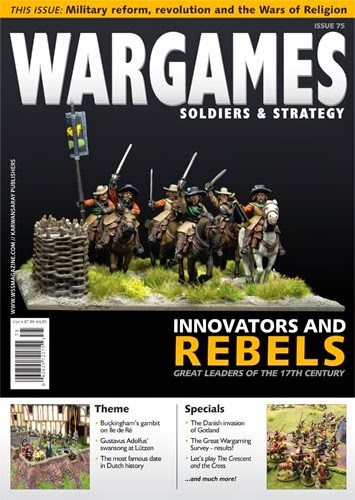
WSS #75


On Friday I received the new issue of Wargames, Soldiers & Strategy. An issue which is of special interest to me, not only because this time the theme is the Thirty Years Wars – an era I have long wanted to take a closer look at, but the timing has never been right (too much other stuff going on) – but also because it features an article by my good mate Dalauppror on the Danish invasion of the island Gotland in 1361. The fact that it even made the cover is fantastic!

This really is an excellent feature, with a comprehensive historical background, lots of nice pictures of lovely painted Danes and four scenarios for Lion Rampant that could be easily adapted to your rules of choice. It's well worth checking out by anyone with the slightest interest in Scandinavian medieval history.

I have contributed by some proof-reading and help in play testing the scenarios, as well as lending parts of my Dark Ages collection to be used as Gutes. If I had known the miniatures would end up on the front cover of WSS 2,5 years later I would have spent some more time on them ...

Anyway, this is not my show but all Dalauppror's – nice work mate and congratulations!